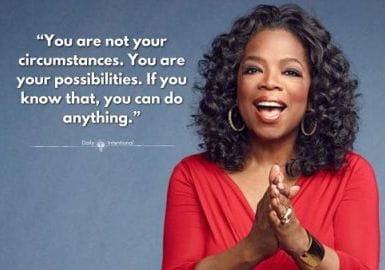
Oprah Winfrey, an Emmy Award-winning talk show host, media executive, Academy Award-nominated actress, and philanthropist, is a name that resonates with millions around the world. She is best known for hosting her internationally popular talk show, “The Oprah Winfrey Show,” which aired for 25 seasons, from 1986 to 2011. The success of her show helped her become the world’s first Black woman billionaire in 2003.
Winfrey’s media empire has grown to include a TV network, the Oprah Winfrey Network, and a lifestyle magazine brand. In 1994, she was inducted into the Television Academy Hall of Fame, and in 2018, became the first Black woman to receive the Cecil B. DeMille Award at the Golden Globes for her outstanding contributions to entertainment.
Early Life and Education
Born on January 29, 1954, in the rural town of Kosciusko, Mississippi, Oprah Gail Winfrey had a challenging childhood. After a troubled adolescence, she moved to Nashville to live with her father, Vernon Winfrey, a barber and businessman. Winfrey attended East Nashville High School and later Tennessee State University, majoring in speech communications and performing arts.
Broadcasting Career
In 1976, Winfrey moved to Baltimore, Maryland, where she hosted the TV talk show “People Are Talking.” The show became a hit, and Winfrey stayed with it for eight years, after which she was recruited by a Chicago TV station to host her own morning show, “A.M. Chicago.”
Philanthropy and Activism
Beyond her media career, Winfrey is also known for her philanthropic efforts and political activism. She has used her platform to raise awareness about various social issues and has made significant contributions to various causes.
Top 25 Quotes from Oprah Winfrey
“You don’t get what you want in life, you get what you intend.”
“Passion is energy. Feel the power that comes from focusing on what excites you.”
“Turn your wounds into wisdom.”
“Challenges are gifts that force us to search for a new center of gravity. Don’t fight them. Just find a new way to stand.”
“Leadership is about empathy. It is about having the ability to relate to and connect with people for the purpose of inspiring and empowering their lives.”
“You are responsible for your life. You can’t keep blaming somebody else for your dysfunction. Life is really about moving on.”
“You are not your circumstances. You are your possibilities. If you know that, you can do anything.”
“Let excellence be your brand… When you are excellent, you become unforgettable. Doing the right thing, even when nobody knows you’re doing the right thing will always bring the right thing to you.”
“You want to be in the driver’s seat of your own life because if you are not, life will drive you.”
“Be thankful for what you have; you’ll end up having more. If you concentrate on what you don’t have, you will never, ever have enough.”
“The greatest discovery of all time is that a person can change his future by merely changing his attitude.”
“The thrill is to keep envisioning what can be.”
“You are responsible for your life. You can’t keep blaming somebody else for your dysfunction. Life is really about moving on.”
“Courage is feeling the fear and doing it anyway.”
“Leadership is about empathy. It is about having the ability to relate to and connect with people for the purpose of inspiring and empowering their lives.”
“No experience is wasted. Everything in life is happening to grow you up, to fill you up, to help you become more of who you were created to be.”
“A mentor is someone who allows you to see the hope inside yourself.”
“You get in life what you have the courage to ask for.”
“The biggest adventure you can ever take is to live the life of your dreams.”
“If a man wants you, nothing can keep him away. If he doesn’t want you, nothing can make him stay.”
“Real integrity is doing the right thing, knowing that nobody’s going to know whether you did it or not.”
“I’ve come to believe that each of us has a personal calling that’s as unique as a fingerprint – and that the best way to succeed is to discover what you love and then find a way to offer it to others in the form of service, working hard, and also allowing the energy of the universe to lead you.”
“I trust that everything happens for a reason, even if we are not wise enough to see it.”
“Breathe. Let go. And remind yourself that this very moment is the only one you know you have for sure.”
“The more you praise and celebrate your life, the more there is in life to celebrate.”
Oprah Winfrey’s life and career are a testament to the power of perseverance, self-belief, and the pursuit of excellence. Her journey from a small town in Mississippi to becoming a global media mogul is an inspiration to many, and her words continue to motivate and empower people around the world.
“We suffer more often in imagination than in reality.” – Seneca
This profound quote from the Stoic philosopher Seneca encapsulates a timeless truth about the human condition. It speaks to the power of our minds to create scenarios and situations that cause us more distress and suffering than the actual events of our lives. Let’s delve deeper into this concept and explore how we can apply Seneca’s wisdom to our daily lives.
The Imagined vs. The Real
Our minds are incredibly powerful tools. They have the ability to imagine scenarios, replay past events, and anticipate future ones. However, this power can also be a source of suffering. We often find ourselves worrying about things that have not happened yet or dwelling on things that have already passed. This is what Seneca meant when he said we suffer more in our imagination than in reality.
For instance, consider a person who is anxious about giving a presentation. They might spend days or even weeks worrying about it, imagining all sorts of negative outcomes. They might lose sleep, experience stress, and even physical discomfort. Yet, when the day of the presentation comes, it often goes better than they imagined, and their worry is revealed to be unnecessary.
The Power of Now
The key to overcoming this unnecessary suffering lies in the present moment. By focusing on the here and now, we can alleviate much of the stress and anxiety caused by our imagination. This is a concept found not only in Stoicism but also in many mindfulness and meditation practices.
When we are fully present, we are not worried about the future or regretting the past. We are focused on what is happening right now, and this focus allows us to take action and make decisions based on reality, not our imagined fears or regrets.
Applying Seneca’s Wisdom
So, how can we apply Seneca’s wisdom to our lives? Here are a few practical steps:
Awareness: The first step is to become aware of when you are causing yourself unnecessary suffering through your imagination. Notice when you are worrying about the future or dwelling on the past.
Mindfulness: Practice being in the present moment. This could be through meditation, mindful breathing, or simply paying attention to your surroundings and what you are doing.
Action: Take action based on the reality of the situation, not your imagined fears or regrets. If you are worried about a presentation, prepare for it. If you are regretting a past mistake, learn from it and move on.
While our minds are powerful tools, they can also cause us unnecessary suffering. By understanding and applying Seneca’s wisdom, we can learn to use our minds in a way that serves us, rather than causes us distress. Remember, we suffer more often in imagination than in reality. So, let’s focus on the reality and live in the present moment.
To learn more about Stoicism, we highly recommend The Daily Stoic by Ryan Holiday and Stephen Hanselman available at https://amzn.to/4deh8f6
“Whatever the present moment contains, accept it as if you had chosen it.”
It’s easy to get lost in the whirlwind of past regrets and future anxieties. But what if the key to peace and fulfillment lies not in the past or the future, but in the present moment?
Eckhart Tolle, a renowned spiritual teacher and author of the transformative book “The Power of Now”, offers a profound yet simple solution – living in the now. This article delves into one of his powerful quotes, “Whatever the present moment contains, accept it as if you had chosen it.” and explores the importance of mindfulness and the power of living in the present moment.
The Trap of Time
In our fast-paced world, it’s easy to fall into the trap of time. We often find ourselves either dwelling on the past or worrying about the future. We replay past mistakes over and over again in our minds, or we live in constant fear of what the future might bring. This constant time-traveling in our minds robs us of the joy and peace that can only be found in the present moment.
The Power of Now
The present moment is all we truly have. The past is a memory and the future is a projection. The present moment is where life happens. When we fully engage with the present, we open ourselves up to experiencing life in its fullest depth and richness.
Eckhart Tolle’s quote invites us to accept the present moment as it is, without judgment or resistance. This acceptance doesn’t mean that we resign ourselves to whatever is happening. Instead, it means that we acknowledge the reality of the present moment without wishing it were different. This acceptance creates a space for peace and clarity, from which we can then take conscious and deliberate action.
The Practice of Mindfulness
Mindfulness is the practice of bringing our attention back to the present moment. It’s about noticing what’s happening right now, both within us and around us, without getting caught up in thoughts about the past or the future.
When we practice mindfulness, we train ourselves to become more present and aware. We learn to observe our thoughts and feelings without getting swept away by them. We learn to accept the present moment as it is, which can lead to a profound sense of peace and contentment.
Living in the now is not about ignoring the past or the future. It’s about recognizing that the only moment we truly have is the present moment, and choosing to live it fully. As we cultivate mindfulness and learn to live in the now, we can experience a deeper sense of peace, joy, and fulfillment in our lives.
Grab your copy of The Power of Now by Eckhart Tolle at https://amzn.to/3Jy0o4T

All gave some. Some gave ALL ! ! !
Most people get Memorial Day and Veterans Day confused. Do you know the difference between them? If not, then this article is for you to clarify the difference between them.
Memorial Day: Honoring Fallen Heroes
Memorial Day, originally known as Decoration Day, has a rich history that dates back to the aftermath of the American Civil War. Here are the key points about Memorial Day:
Purpose: Memorial Day is a solemn occasion dedicated to remembering and honoring military personnel who have died while serving in the United States armed forces. It is a day to pay tribute to those who made the ultimate sacrifice for their country.
Origins: The first observance of what would become Memorial Day is believed to have taken place in Charleston, South Carolina, shortly after the Civil War. Freed slaves organized a burial event for Union prisoners of war, and this commemoration marked the beginning of the tradition.
Local Observances: Communities across the country held local observances to honor soldiers with neglected gravesites. These early commemorations eventually evolved into the national holiday we know today.
Decoration Day: The tradition of placing flowers on veterans’ graves continued, and in 1868, Decoration Day was officially established by the Grand Army of the Republic, an organization of Union veterans. General Ulysses S. Grant presided over the first large observance at Arlington National Cemetery.
Evolution: Over time, Memorial Day expanded beyond honoring Civil War soldiers to include all Americans who have served in the military. It remains a day of reflection, remembrance, and gratitude.
Veterans Day: Honoring All Service Members
Veterans Day, on the other hand, has a different focus. Here’s what you need to know:
Purpose: Veterans Day, observed on November 11th, honors all military service members—both living and deceased. It recognizes the contributions and sacrifices of those who have served in the armed forces.
World War I Origins: Veterans Day originated at the end of World War I. It was initially called Armistice Day, commemorating the armistice (ceasefire) that ended the war on November 11, 1918.
Name Change: In 1954, after World War II and the Korean War, Congress changed the name to Veterans Day to honor veterans of all wars and conflicts.
Celebration: Veterans Day is a time to express gratitude to living veterans, thank them for their service, and acknowledge their experiences. It’s a day to celebrate their courage and commitment.
While both Memorial Day and Veterans Day honor military service, Memorial Day specifically remembers those who gave their lives in service, whereas Veterans Day celebrates all veterans, living and deceased.
Warren Buffett, one of the most successful investors of all time, has a net worth of $119 billion. He built his wealth by investing and reinvesting in various businesses, eventually taking control of Berkshire Hathaway.
Here are some of the key investing strategies that have contributed to his success.
Value-Based Investing
Buffett is a firm believer in the value-based investing model. He recommends investing in companies that have solid fundamentals, strong earning power, and potential for continued growth. This approach was influenced by his mentor Benjamin Graham, who is often considered the “father of value investing”.
Business Tenets
Buffett limits his investments to businesses he can easily understand. He believes in understanding a company’s operational philosophy as it’s crucial to reliably project its performance.
Management Tenets
Buffett evaluates the track records of a company’s management. He favors companies that distribute dividend earnings to shareholders and is drawn to transparent companies that admit their mistakes.
Financial Measures
In the financial measures category, Buffett focuses on companies with low leverage and high profit margins. He values the importance of the economic value added (EVA) calculation, which estimates a company’s profits after the shareholders’ stake is removed from the equation.
Investing in Index Funds
Despite making his fortune as an active investor, Buffett acknowledges that most people will get better results by investing in a broadly diversified index fund.
If you’re interested in learning more about Warren Buffett’s investment strategies, consider reading his book, “The Warren Buffett Way”.
It provides an in-depth look at his philosophies and techniques, offering valuable insights for investors of all levels.
Don’t miss out on the opportunity to learn from one of the world’s best investors. Get your copy today at https://amzn.to/44hIvRv
