3 Strategies to Confidently Prioritize Consistency

3 Strategies to Confidently Prioritize Consistency

We live in a culture that worships the “big break,” the overnight success, and the heroic effort. We are told that to change our lives, we must overhaul everything at once, launch ourselves into a frenzy of activity, and sustain a high-octane intensity until we reach the finish line. But for most of us, this approach leads to a predictable cycle of burnout and abandonment. 

The truth is that intensity is a finite resource, but consistency is a compound interest engine. The most profound changes in our health, wealth, and relationships don’t come from the days we give 110%; they come from the thousands of days we simply gave 20% when we wanted to give zero.

The Biological Limits of Intensity

Intensity relies heavily on willpower, which is controlled by the prefrontal cortex. This part of the brain is sophisticated but tires easily. When you try to change your life through sheer intensity—like starting a two-hour-a-day gym routine when you haven’t moved in months—your brain eventually views this as a threat to its energy reserves. This triggers a “rebellion” that manifests as procrastination or total quitting.

Consistency, however, leverages the basal ganglia, the part of the brain responsible for habit formation. By repeating small actions “with care,” you move the behavior from an effortful choice to an automatic reflex. While intensity feels like a battle, consistency eventually feels like a rhythm.

The Compound Effect of “Repeated with Care”

There is a specific reason the quote mentions “care.” Repetition without intention is just a rut. But repetition with care is a craft. This is the difference between mindlessly going through the motions and deliberate practice.

When you perform an act consistently and intentionally: 

  • You lower the barrier to entry: The “startup cost” of beginning the task disappears.
  • You build an identity: You stop saying “I’m trying to write” and start saying “I am a writer” because the evidence is in your daily schedule.
  • You benefit from compounding: A 1% improvement every day results in being 37 times better by the end of a year. Intensity cannot match that math.

Why Intensity Is Often a Distraction

Often, we choose intensity because it feels more productive than it actually is. A weekend of “hustling” feels impressive, but it often masks a lack of a sustainable system. People use intensity to compensate for a lack of discipline. They try to “cram” for success the same way they once crammed for a college exam.

However, success in life isn’t a test you can pass and then forget. It is a garden that requires daily, mundane maintenance. If you water a plant with ten gallons of water once a month (intensity), it will die. If you give it a cup of water every day (consistency), it will thrive. The same is true for your Daily Intentional goals.

Three Strategies to Prioritize Consistency

To move away from the “all-or-nothing” trap, implement these evergreen strategies for long-term adherence:

  • The “Never Miss Twice” Rule: Perfection is the enemy of consistency. If you miss a day of your habit due to unforeseen circumstances, your only goal is to ensure you do not miss the second day. One miss is an accident; two misses is the start of a new, negative habit.
  • Reduce the Scope, Keep the Schedule: On days when your energy is low, don’t skip the task—simply reduce it. If you can’t do a 30-minute workout, do five pushups. If you can’t write a thousand words, write a sentence. This keeps the neural pathways of the habit alive.
  • Focus on the System, Not the Goal: Goals are about the results you want to achieve; systems are about the processes that lead to those results. When you fall in love with the process, the intensity becomes unnecessary because the system handles the heavy lifting.

The Legacy of the Long Game

In the end, your life will not be defined by the few times you did something extraordinary. It will be defined by the things you did every single day. Intensity might win the sprint and garner the most attention, but consistency wins the marathon and earns the most respect. By choosing to show up with care, day after day, you are building a foundation that no amount of short-term effort can ever replace.

Daily Reflection: The Grace to Begin Small Towards An Aligned Mindset

Daily Reflection: The Grace to Begin Small Towards An Aligned Mindset

“Quiet daily choices matter because humble starts often lead to meaningful change.”

It is easy to overlook what is small because it does not announce itself. Yet repeated thoughts, repeated choices, and repeated actions shape the tone of a life more than occasional bursts of intensity.

When the day feels discouraging, the temptation is to believe that only dramatic change counts. It does not. The steady things still matter, especially when they seem ordinary.

This is why gentle consistency carries so much strength. It keeps you connected to what is true, helps you return after setbacks, and gives your life a rhythm that can hold real growth.

Carry that with you today. Honor the simple thing that matters, stay with it a little longer, and trust that quiet faithfulness is doing more than you can see.

Reflection: Where are you being invited to remember that humble starts often lead to meaningful change, and how could that change the way you move through today?

Ready to challenge yourself?  Get INSTANT ACCESS to The Daily Intentional Habits Bundle today at https://dailyintentional.com/daily-intentional-habits-bundle/ 

Want the best in entertainment? Visit POPUTAINMENT.COM

The Discipline of Peace

The Discipline of Peace

“Quiet choices often carry more strength than loud intentions.”

The Discipline of Peace is a reminder that lasting change is often shaped in ordinary moments.

What feels small today can still be meaningful. The choices you repeat gently shape your perspective, your habits, and the way you move through the world.

When the day becomes noisy or heavy, it is easy to forget that one honest response can shift more than panic ever will. You do not need to control everything to move well.

Often the wiser path is to become quiet enough to notice what is true, what is needed, and what can be done with care right now. That kind of clarity creates steadier progress.

Let this be your reminder today: stay near what matters, honor the next right step, and trust the quiet work that is happening within you.

Reflection: Where in your life does the message of the discipline of peace speak to you most right now, and what would it look like to live it out today?

The Long View

The Long View

“What is repeated with care often matters because long-term thinking reduces short-term frustration.”

It is easy to overlook what is small because it does not announce itself. Yet repeated thoughts, repeated choices, and repeated actions shape the tone of a life more than occasional bursts of intensity.

When the day feels discouraging, the temptation is to believe that only dramatic change counts. It does not. The steady things still matter, especially when they seem ordinary.

This is why gentle consistency carries so much strength. It keeps you connected to what is true, helps you return after setbacks, and gives your life a rhythm that can hold real growth.

Carry that with you today. Honor the simple thing that matters, stay with it a little longer, and trust that quiet faithfulness is doing more than you can see.

Reflection: Where are you being invited to remember that long-term thinking reduces short-term frustration, and how could that change the way you move through today?

The Gift of Today

The Gift of Today

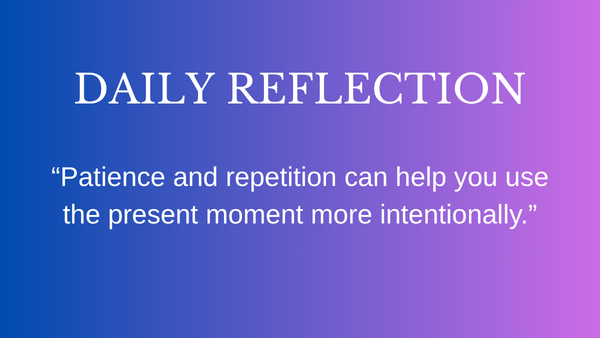
“Patience and repetition can help you use the present moment more intentionally.”

The Gift of Today is a reminder that you can use the present moment more intentionally, even if the way forward feels smaller than you expected.

The process may not feel dramatic, but it becomes real when you choose one clear action instead of waiting for a perfect mood, a perfect plan, or a perfect day.

When progress feels slow, remember that one missed step does not erase the path. What matters is your willingness to return with honesty and begin again from where you are.

Often the next right move is surprisingly simple: pause, breathe, tell yourself the truth, and do the next thing that is both wise and possible. Small movement creates room for larger change.

Let this encourage you today. You do not have to force the whole journey at once. If you stay close to the next faithful step, momentum will begin to gather in quiet and lasting ways.

Reflection: Where in your life do you most need to use the present moment more intentionally, and what is one small step you can take today?

What You Can Carry

What You Can Carry

“Small steady choices can help you let go of unnecessary emotional burdens.”

What You Can Carry is a reminder that you can let go of unnecessary emotional burdens, even if the way forward feels smaller than you expected.

The process may not feel dramatic, but it becomes real when you choose one clear action instead of waiting for a perfect mood, a perfect plan, or a perfect day.

When progress feels slow, remember that one missed step does not erase the path. What matters is your willingness to return with honesty and begin again from where you are.

Often the next right move is surprisingly simple: pause, breathe, tell yourself the truth, and do the next thing that is both wise and possible. Small movement creates room for larger change.

Let this encourage you today. You do not have to force the whole journey at once. If you stay close to the next faithful step, momentum will begin to gather in quiet and lasting ways.

Reflection: Where in your life do you most need to let go of unnecessary emotional burdens, and what is one small step you can take today?