
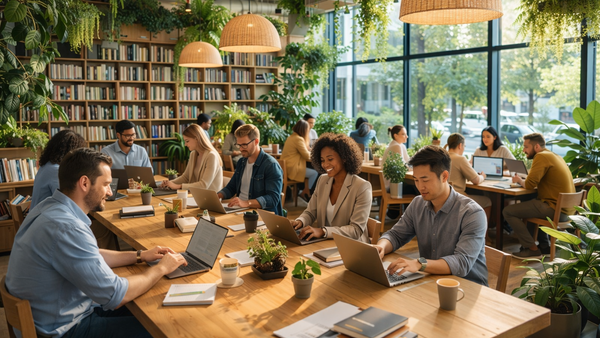
The dream of the permanent home office is starting to show its cracks. While the commute-free life promised ultimate freedom, many are finding that total isolation is a recipe for cognitive stagnation. The walls of your spare bedroom don’t provide the friction necessary for high-level thinking, and the lack of human energy is quietly draining your creative battery.
We are currently seeing a massive shift toward curated proximity. People are realizing that they don’t just need a desk; they need an environment that triggers a different psychological state. This isn’t a return to the traditional corporate cubicle—it’s the rise of the intentional creative hub.
The friction of new ideas
Creativity thrives on accidental collisions. In a solo home environment, your inputs are curated and predictable. You see the same four walls and interact with the same digital algorithms every day. This creates a mental echo chamber where your ideas eventually stop evolving.
When you step into a shared creative space, you introduce healthy friction. A brief conversation at a coffee station or simply working in a room full of people focused on different industries provides the subconscious cues your brain needs to problem-solve. It’s the difference between a closed loop and an open circuit.
The neurology of shared focus
There is a documented phenomenon known as body doubling, where being in the presence of others who are also working increases your own focus and task completion. It’s a form of passive accountability that doesn’t require a single word to be spoken. Your nervous system picks up on the collective focus of the room, making it easier for you to drop into a flow state.
This shared energy is a powerful antidote to the brain fog that often accompanies long-term remote work. By changing your environment, you signal to your brain that it’s time for high-output work, allowing your home to return to being a place of actual rest.
Protecting your human capital
We have to stop viewing the cost of a shared workspace or a social club as an overhead expense and start seeing it as an investment in our mental longevity. Burnout often stems from a lack of variety and a lack of support. Being part of a physical community provides a sense of perspective that is impossible to find through a screen.
The shift we’re seeing is about reclaiming the social element of our professional lives. It’s about choosing where and who we work around to maximize our output while protecting our peace. The future of work isn’t at a kitchen table; it’s in spaces designed for human connection and collective ambition.
The era of the isolated genius is ending. We are moving toward a model where our environment does the heavy lifting for our discipline. By placing yourself in the right room, you aren’t just getting your work done—you’re ensuring that your mind stays sharp, your network stays organic, and your life stays balanced.